RU 66 Crossed Roller Bearing Dimensions & Loads Wholesale Supplier
Prevent premature RU 66 crossed roller bearing failure caused by dimensional mismatch and improper installation. Verify ISO standard tolerances, calculate dynamic loads accurately, and apply correct mounting techniques to ensure rigidity. Source from suppliers providing verified drawings to avoid costly retrofitting delays and guarantee precision application reliability.

RU 66 Crossed Roller Bearing Dimensions & Loads Wholesale Supplier
The most common reason for premature RU 66 failure is not load capacity, but dimensional mismatch during installation.
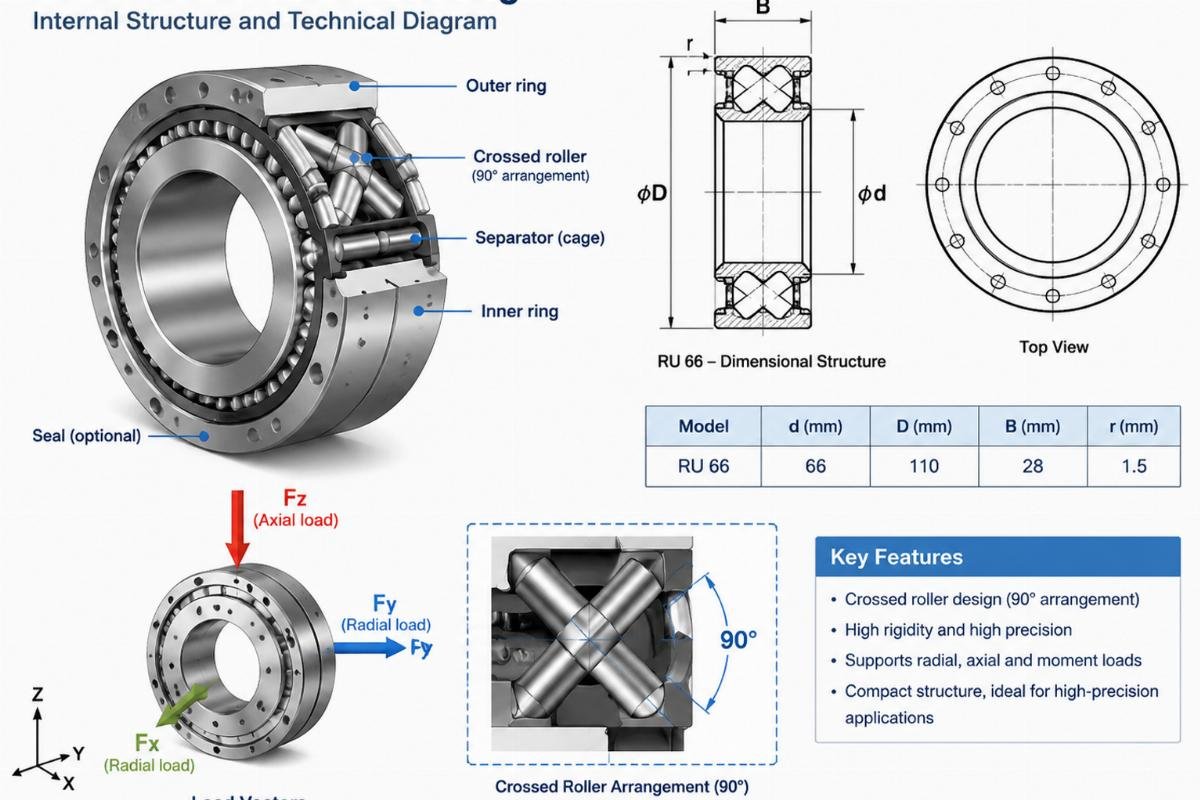
For buyers sourcing a RU 66 crossed roller bearing, the critical specification is the precise alignment of inner and outer ring diameters with the mounting housing. The standard RU 66 design features a compact cross-section with rollers arranged at 45-degree angles, allowing it to handle radial, axial, and moment loads simultaneously. When selecting this component, verify that the bore and outside diameter tolerances match ISO standards for precision applications. A RU 66 crossed roller bearing must be paired with accurate preload settings to ensure rigidity without excessive friction. Sourcing from a supplier who provides verified dimensional drawings prevents costly retrofitting delays.
Understanding these parameters requires more than reading a catalog. It demands familiarity with how these thin-wall components behave under real-world stress. I recall a shipment destined for a manufacturing hub in Latin America where the documentation listed generic dimensions. The local team attempted to install the units into a robotic arm assembly, only to find the outer ring interfered with the housing shoulder. The issue was not the bearing itself, but a lack of clarity on the chamfer dimensions in the provided datasheet. This incident reinforced the need to treat every RU 66 crossed roller bearing spec sheet as a legal document, ensuring every micron aligns with the mechanical design before production begins.
Why Do Standard Dimension Charts Fail in Precision Applications?
Catalog dimensions often omit critical geometric tolerances that affect fit and function.
Many buyers assume that a standard part number guarantees interchangeability. However, the RU 66 crossed roller bearing is a precision component where minor deviations in roundness or parallelism can lead to vibration and early fatigue. Standard charts typically list nominal diameters and width, but they rarely detail the runout limits or the specific surface finish requirements for the raceways. [NEED_CITE: ISO tolerance classes for precision rolling bearings]
Consider the difference between a standard industrial grade and a precision grade. While both may share the same basic dimensions, the precision grade maintains tighter control over radial play. In high-speed indexing tables or medical imaging equipment, this distinction is vital. A buyer once sourced a batch based solely on outer diameter and width, ignoring the internal clearance class. The result was noticeable wobble in the final assembly, requiring a complete teardown.
| Parameter | Standard Industrial Grade | Precision Grade |
|---|---|---|
| Radial Runout | Noticeably higher tolerance | Micron-level precision |
| Surface Finish | Standard machined | Super-finished raceways |
| Internal Clearance | Uncontrolled/Standard | Controlled/C3 or C2 |
| Load Distribution | Uneven under misalignment | Uniform across rollers |
This table highlights why relying on basic dimensions is insufficient. The RU 66 crossed roller bearing relies on the integrity of its raceway geometry to distribute loads evenly. If the raceways are not perfectly parallel, the rollers will skid rather than roll, generating heat and wear. [NEED_CITE: Mechanisms of rolling element bearing failure]
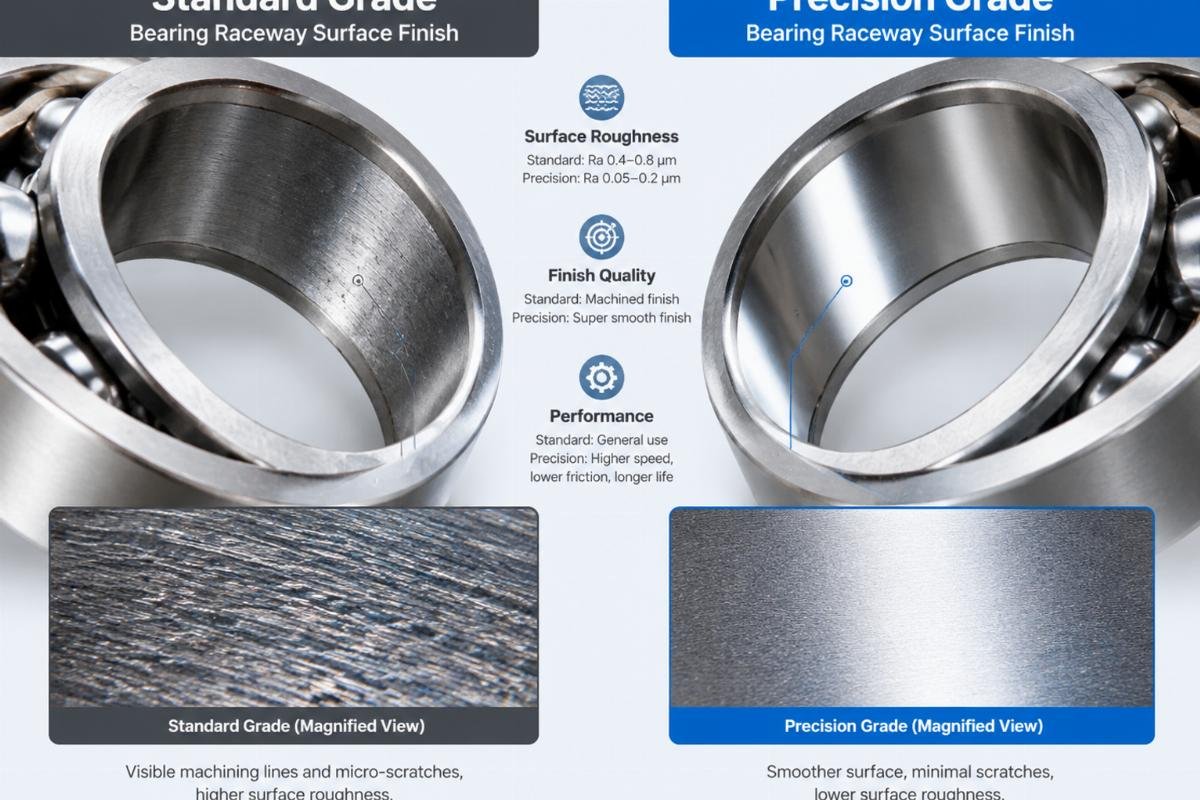
When evaluating suppliers, request detailed inspection reports that include geometric tolerances, not just basic size checks. This level of transparency ensures that the RU 66 crossed roller bearing you receive meets the rigorous demands of your application. It also simplifies the quality assurance process on your end, reducing the risk of receiving non-conforming stock.
How Does Load Capacity Impact Bearing Selection?
Static load ratings are irrelevant if dynamic load conditions are misunderstood.
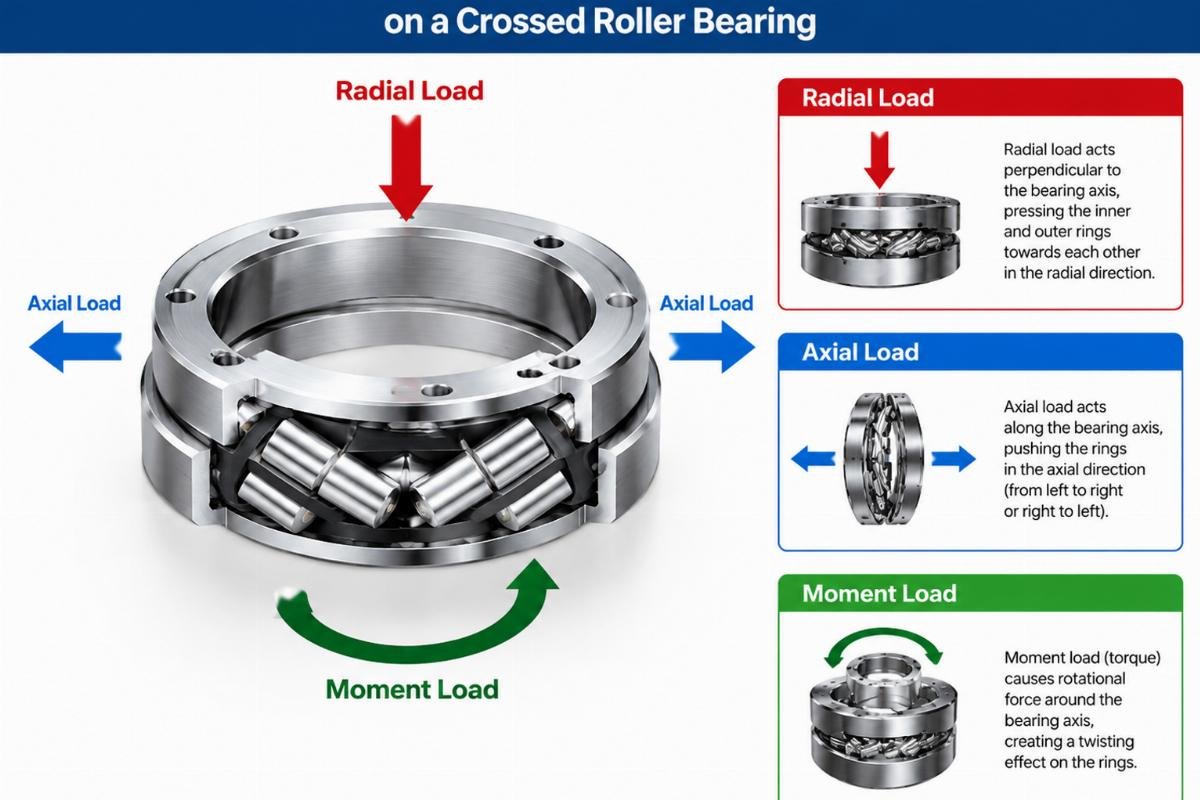
The RU 66 crossed roller bearing is designed to support combined loads, but its capacity is highly dependent on the operating environment. Many buyers focus exclusively on the static load rating, assuming it defines the bearing’s limit. In reality, dynamic loads involving rotation, vibration, and shock have a far greater impact on service life. [NEED_CITE: Calculation methods for bearing life under combined loads]
A European automation integrator once specified a RU 66 crossed roller bearing for a rotary indexing table. They calculated the load based on the weight of the fixture alone, neglecting the inertial forces generated during rapid acceleration and deceleration. The bearing failed prematurely due to fatigue spalling on the raceways. The root cause was not insufficient static capacity, but an underestimation of the dynamic equivalent load.
To avoid this, calculate the equivalent dynamic load using the appropriate factors for radial and axial components. The crossed roller design allows for significant axial load capacity, but this advantage diminishes if the bearing is subjected to excessive moment loads without proper support. Ensure that the mounting structure is rigid enough to prevent deflection, which can concentrate stress on a small subset of rollers.
| Load Type | Impact on RU 66 | Mitigation Strategy |
|---|---|---|
| Radial | Moderate capacity | Ensure proper shaft fit |
| Axial | High capacity | Utilize full complement of rollers |
| Moment | Sensitive to misalignment | Rigid mounting structure required |
| Shock | Risk of brinelling | Select higher dynamic rating |
Understanding these dynamics helps in selecting the right RU 66 crossed roller bearing for your specific needs. It also informs the lubrication strategy, as higher dynamic loads require more robust film strength to prevent metal-to-metal contact. [NEED_CITE: Lubrication requirements for high-load rolling bearings]
Suppliers who provide technical support can help verify these calculations. They can offer insights into how similar applications have performed, helping you avoid common pitfalls. This collaborative approach ensures that the RU 66 crossed roller bearing is not just a commodity item, but a engineered solution tailored to your operational demands.
What Are the Critical Installation Errors to Avoid?
Improper mounting is the leading cause of immediate bearing damage.
Even a perfectly manufactured RU 66 crossed roller bearing can fail if installed incorrectly. The thin-wall construction makes it susceptible to deformation if excessive force is applied during press-fitting. Many technicians use hammers or direct pressure on the rings, which can dent the raceways or misalign the rollers. [NEED_CITE: Best practices for mounting thin-wall bearings]
A maintenance team at a Middle East steel plant encountered this issue during a routine overhaul. They attempted to install a new RU 66 crossed roller bearing into a tight housing using a hydraulic press without a proper mounting sleeve. The outer ring distorted slightly, creating a bind that prevented smooth rotation. The bearing had to be discarded, causing unplanned downtime.
To prevent this, always use a mounting tool that distributes force evenly across the ring being pressed. For the inner ring, press on the inner diameter; for the outer ring, press on the outer diameter. Never transmit force through the rollers or cages. Additionally, ensure that the housing and shaft shoulders are clean and free of burrs, as even small imperfections can cause misalignment.
| Step | Correct Method | Incorrect Method |
|---|---|---|
| Force Application | Even distribution via sleeve | Direct hammer blow |
| Alignment | Check perpendicularity | Assume self-alignment |
| Lubrication | Apply before mounting | Apply after mounting |
| Verification | Rotate manually post-install | Skip manual check |
Following these steps ensures that the RU 66 crossed roller bearing retains its geometric integrity. It also helps in achieving the correct preload, which is essential for stiffness and accuracy. [NEED_CITE: Preload adjustment techniques for precision bearings]

Training your installation team on these specifics can save significant time and money. It transforms the installation process from a risky operation into a standardized procedure. This consistency is key to maintaining the reliability of equipment that depends on the RU 66 crossed roller bearing for precise motion control.
Conclusion
Precision sourcing prevents operational failure.
Selecting the right RU 66 crossed roller bearing requires attention to dimensional tolerances, load dynamics, and installation protocols. By focusing on verified specifications and proper handling, buyers can ensure long-term reliability. This approach minimizes risk and maximizes the performance of precision machinery. A well-sourced RU 66 crossed roller bearing is a foundation for efficient industrial operations.
Share this article

About the author
author
Editor covering global sourcing, supplier verification, and industrial product knowledge. Content is compiled from manufacturer specifications, industry standards, and hands-on experience with international B2B buyers. Every article is fact-checked before publishing to help procurement professionals make informed decisions.


