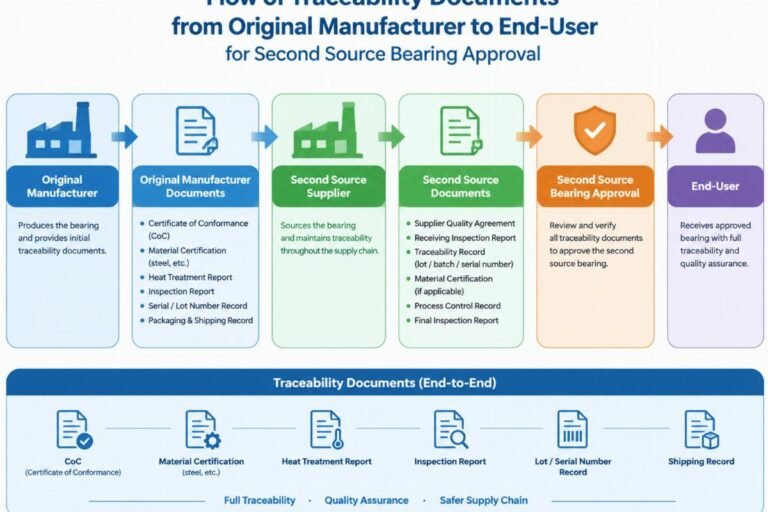
Custom Bearing Designs: Tooling Costs & OEM Supplier Solutions
Prevent margin erosion by explicitly allocating custom bearing tooling costs before quoting unit prices. Separate mold, fixture, and gauge expenses from piece prices to ensure amortization aligns with realistic production volumes. Demand transparent breakdowns and clear MOQ calculations to avoid hidden fees in OEM procurement.

Custom Bearing Designs: Tooling Costs & OEM Supplier Solutions
A low unit price often hides unamortized tooling fees.
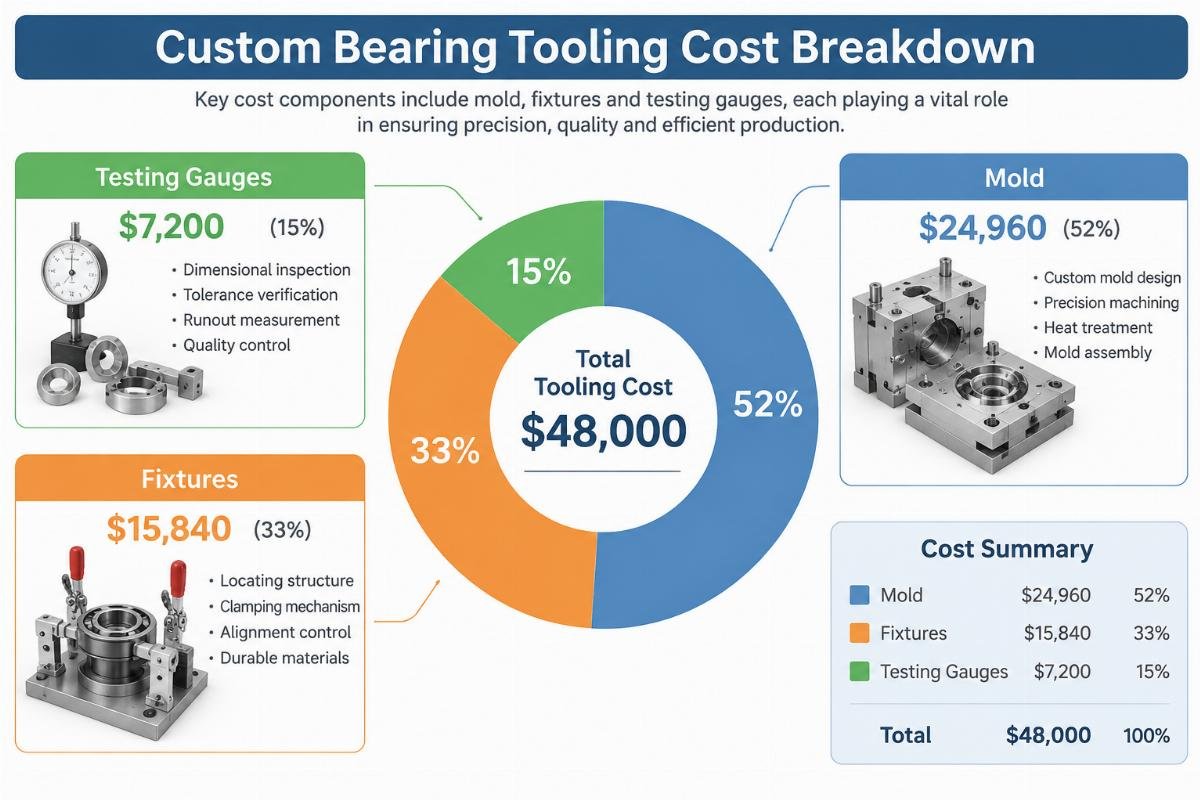
Tooling costs for custom bearings must be explicitly allocated and tied to MOQ calculations before quoting to prevent margin erosion. Buyers should demand a clear breakdown of mold, fixture, and gauge expenses separate from the per-unit piece price, ensuring that amortization schedules align with realistic production volumes rather than optimistic forecasts.
I still remember the chill in the air at the Hanover Messe when a German engineer approached my booth. He needed a deep-groove ball bearing with a special seal groove for a high-speed spindle application. The design was non-standard, but the volume looked promising. Eager to secure the deal, I quoted a competitive unit price based on standard manufacturing rates, treating the custom geometry as a minor modification. I did not itemize the tooling. When the sample phase began, the factory demanded a substantial fee for the specific mold and testing gauges required to hold the tight tolerances of the seal groove. The OEM client refused to pay, citing my initial quote. I absorbed the cost, turning a potential profit into a significant loss. That incident reshaped how I approach every inquiry involving non-standard geometries. It is not just about the metal; it is about the infrastructure required to shape it. [NEED_CITE: industry standard practices for custom component procurement]
Understanding this dynamic is critical for any procurement professional dealing with specialized industrial components. Without a transparent structure for custom bearing tooling costs, projects frequently spiral into budget overruns or supply chain delays.
What Exactly is Included in Custom Bearing Tooling Costs?
Tooling is not limited to the primary mold; it encompasses fixtures, gauges, and validation equipment.
When sourcing non-standard bearings, many buyers focus solely on the die or mold used to form the rings. However, the total investment extends far beyond that single component. A comprehensive understanding of custom bearing tooling costs requires examining three distinct categories: the primary forming tools, the holding fixtures, and the quality assurance gauges.
The primary mold or die is the most visible cost. For spherical roller bearings used in heavy equipment, this might involve complex forging dies capable withstanding high pressure. For precision machine-tool bearings, it could involve grinding wheels dressed to specific profiles. But the hidden costs often lie in the fixtures. These are the jigs that hold the bearing components during heat treatment or assembly. If the fixture does not maintain perfect alignment, the final product will fail vibration tests, regardless of the material quality.
Furthermore, custom designs require custom gauges. Standard micrometers cannot verify unique seal grooves or irregular cage pockets. Manufacturers must produce dedicated go/no-go gauges or coordinate measuring machine (CMM) programs specifically for your part number. These are one-time engineering costs that do not scale with volume.
| Cost Component | Description | Amortization Potential |
|---|---|---|
| Primary Mold/Die | Forms the basic shape of rings or cages | High (long lifecycle) |
| Holding Fixtures | Ensures alignment during heat treat/assembly | Medium (wear-dependent) |
| QA Gauges | Verifies non-standard dimensions | Low (often expensed) |
| CMM Programming | Digital validation setup | None (one-time engineering) |
[NEED_CITE: breakdown of manufacturing overhead in precision machining]
A European wind farm operator once faced repeated failures with a custom pitch bearing. The issue was not the steel quality but the lack of proper holding fixtures during the hardening process, leading to microscopic distortions. The manufacturer had not included these fixture costs in the initial custom bearing tooling costs estimate, leading to a dispute when replacements were needed. By identifying all physical and digital tools required upfront, buyers can avoid such surprises.

How Should Tooling Fees Be Allocated Between Buyer and Supplier?
Allocation models determine who bears the risk of project cancellation or design changes.
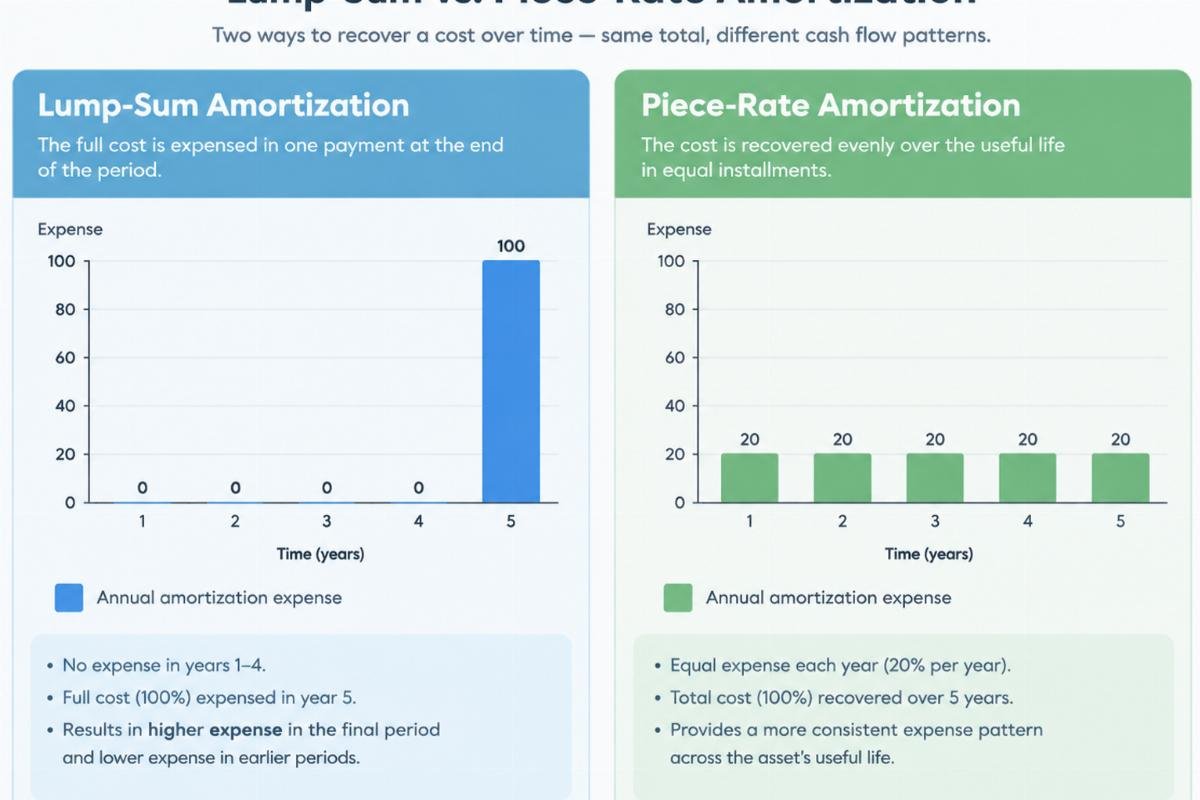
There are two primary methods for handling custom bearing tooling costs: lump-sum payment and piece-rate amortization. Each carries different implications for cash flow and ownership.
In the lump-sum model, the buyer pays the full cost of the tooling upfront. This approach grants the buyer immediate ownership of the molds and fixtures. It is ideal for projects with uncertain long-term volumes or where the buyer intends to switch suppliers after the initial batch. However, it requires significant capital expenditure before a single bearing is produced.
In the piece-rate amortization model, the supplier absorbs the initial tooling cost and recovers it by adding a surcharge to each unit sold. This lowers the barrier to entry for the buyer. Yet, it creates a dependency. If the order volume drops, the supplier may raise prices to recover their investment. Conversely, if volumes exceed expectations, the buyer continues to pay for tools that have long been paid off.
A Middle East steel mill recently negotiated a contract for custom cylindrical roller bearings. They opted for amortization to preserve cash flow. However, the contract lacked a clause specifying when the amortization would end. After producing twice the expected volume, they were still paying the tooling surcharge. Clear terms defining the break-even point are essential. [NEED_CITE: contractual best practices for industrial supply agreements]
Negotiating the allocation of custom bearing tooling costs requires balancing risk. Buyers should seek a hybrid approach: a partial upfront payment to cover raw materials for the tools, with the remainder amortized over a defined quantity. This ensures shared commitment and prevents either party from bearing disproportionate risk.
How to Calculate the Right MOQ to Cover Tooling Investments?
MOQ is not just a production constraint; it is a financial break-even calculation.
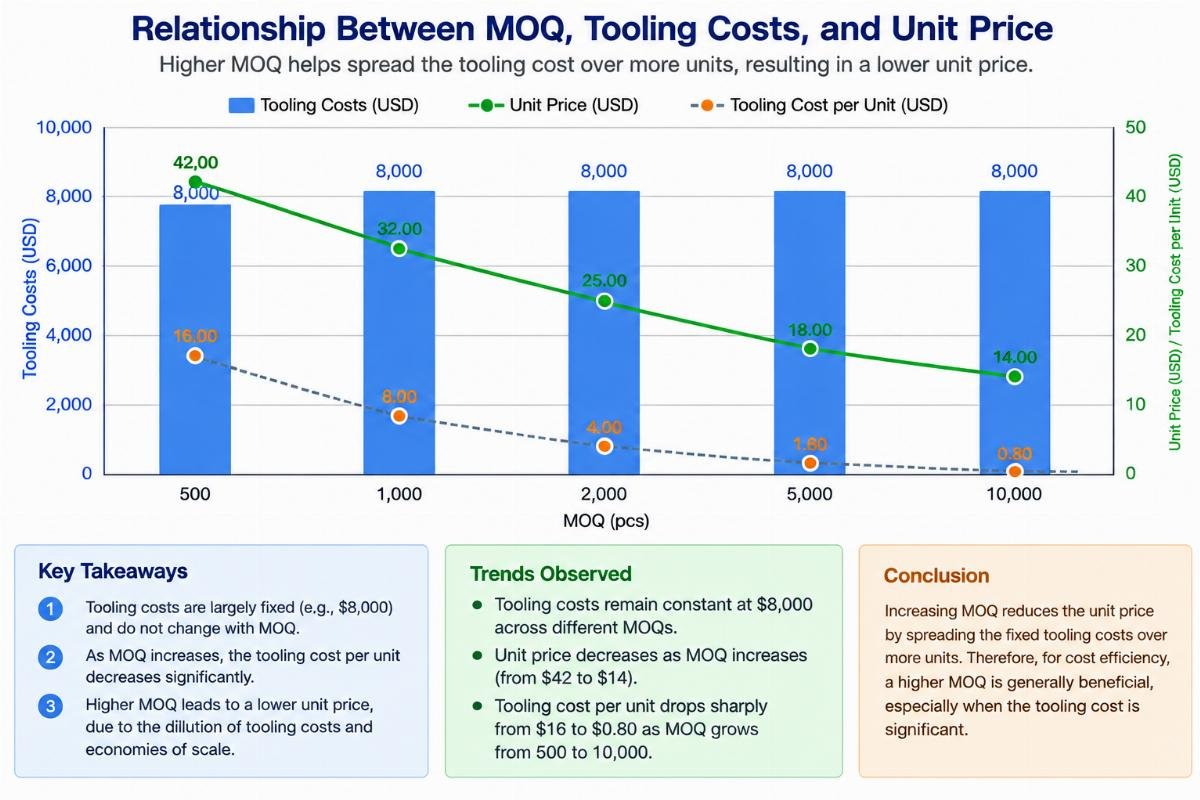
Minimum Order Quantity (MOQ) is often viewed as a supplier imposition. In reality, it is a mathematical necessity derived from custom bearing tooling costs. Calculating the right MOQ ensures that the tooling investment is recovered without inflating the unit price to uncompetitive levels.
The break-even volume is determined by dividing the total tooling cost by the margin per unit. If the tooling costs are high and the margin per bearing is low, the MOQ must be substantial. For example, a precision angular contact bearing with a complex ceramic hybrid design may have high tooling costs due to the difficulty of machining ceramic balls. If the per-unit profit is small, thousands of units may be needed to amortize the setup.
Conversely, for a simple deep-groove ball bearing with a minor dimensional change, the tooling cost is lower. The MOQ can be smaller because the amortization burden is lighter. However, material waste must be controlled. Higher MOQs do not always mean lower per-unit tooling costs if the manufacturing process generates significant scrap. [NEED_CITE: lean manufacturing principles in bearing production]
| Scenario | Tooling Complexity | Margin Per Unit | Recommended MOQ Strategy |
|---|---|---|---|
| Simple Modification | Low | Low | Moderate MOQ |
| Complex Geometry | High | High | Lower MOQ possible |
| High Volume Standard | Low | Very Low | High MOQ |
| Prototype Batch | High | N/A | Full Tooling Cost Upfront |
A manufacturer of agricultural machinery once requested a small batch of custom tapered roller bearings. The supplier quoted a high MOQ to spread the custom bearing tooling costs. By analyzing the break-even volume, the buyer realized that ordering a larger batch for future maintenance stock would reduce the effective unit cost by a noticeable margin. This strategic stocking turned a procurement hurdle into a cost-saving opportunity.
What Contract Clauses Protect Buyers from Hidden Tooling Traps?
Intellectual property and maintenance terms define the long-term value of your investment.
Paying for tooling does not automatically grant ownership or guarantee performance. Specific contract clauses are necessary to protect buyers from hidden traps associated with custom bearing tooling costs.
First, intellectual property (IP) ownership must be explicit. Does the buyer own the mold, or just the right to use it? If the supplier goes out of business, can the buyer retrieve the tools? Without clear IP clauses, the tools may become hostage to the supplier’s financial health.
Second, mold maintenance terms are critical. Tools wear out. Who pays for refurbishment? Is there a guaranteed number of cycles before the supplier must replace the mold at their own cost? A lack of clarity here can lead to quality degradation over time. [NEED_CITE: legal standards for industrial tooling agreements]
Third, include a clause for tooling transfer. If the buyer decides to switch suppliers, the contract should specify the process and cost for transferring the molds to a new manufacturer. This prevents vendor lock-in and ensures continuity of supply.

By addressing these legal aspects, buyers transform custom bearing tooling costs from a sunk expense into a managed asset. This proactive approach safeguards the supply chain and ensures that the investment in custom designs yields long-term operational benefits.
Conclusion
Transparent tooling allocation prevents margin erosion.
Custom bearing projects succeed when tooling costs are separated from unit prices and tied to realistic MOQs. Buyers must demand clarity on what is included in the tooling package, negotiate fair amortization terms, and secure IP rights in contracts. This disciplined approach turns potential financial pitfalls into structured, predictable investments.
Share this article

About the author
author
Editor covering global sourcing, supplier verification, and industrial product knowledge. Content is compiled from manufacturer specifications, industry standards, and hands-on experience with international B2B buyers. Every article is fact-checked before publishing to help procurement professionals make informed decisions.